Category: mental illness

  • Why, no. I am not exactly resilient. That word is weird/conflicted.  I’ll survive anyway.

    Why, no. I am not exactly resilient. That word is weird/conflicted. I’ll survive anyway.

    I’ve seen the words ‘resilient’, ‘resilience’, and ‘resiliency’ pop up again and again in conference presentations, scholarly papers, speeches, book titles, and within my professional community and others. It has become a highly praised attribute in the work force. From librarians (right now, during the pandemic) to students deal with also pandemic but also school stressors and anxieties. We are resilient or encouraged to be. To “bounce back” with speed. To work past it quickly and efficiently. Well, I can’t do that.

    Recovering from a trauma situation is a long process. In my experience anyway, but the words and phrases “quickly” and sayings “bounce back” and “suck it up” are repeated so often in what feels like almost every conceivable avenue. I keep wondering, why? Why isn’t recovery, growth, failure, and struggle also acknowledged and praised as strongly? Most importantly the last two.

    I couldn’t resist a bouncy castle/house image in this post. Courtesy of KXXV 25 News.

    I have never thought of myself as resilient especially now that I know what the expectations of “resiliency” actually are. I went to dictionaries. I love a definition. From Oxford English Dictionary (OED), resilient is “(adj.)….tending to recover quickly or easily from misfortune, shock, illness, or the like; buoyant, irrepressible; adaptable, robust, hardy..” (para. 3). Merriam Webster (2020, para. 1) (adj.)…describes the word similarly, “capable of withstanding shock without permanent deformation or ruptur; tending to recover from or adjust easily to misfortune or change”.

    I don’t know what to say about those definitions in general, but they are not me or anything I am capable doing of today or ever in recent memory. The resilient brings to mind someone strong. Someone who doesn’t take the often just plain awfulness of life too seriously. Someone who moves through life in stride. Maybe a bump or two, but gets back up and gets going.

    I do not believe that I am a ‘resilient person’ as I’ve read so often. Or I don’t think I am judging by the definitions and what has been written about resiliency (Scott, 2020). The School of Continuing Education in the university where I work is hosting an “Emotional Resiliency in Uncertain Times” workshop. (As a side note, I feel like most of my time is uncertain. Today, tomorrow, and on are more than a bit mysterious, as far as WTF I will feel or think or worry or cry about.). When I first read about this workshop, my gut instinct erupted as a question: “what’s wrong with being emotional when the world is on fire and dramatically spiraling downward or at least uncertain?” Answer: nothing.

    I’m still trying to understand the different terminology when it comes to resilience/resilient/resiliency. Each means something slightly different for the individual or at least from what I understand from the marginally varying definitions. For some reason, the word ‘resilient’ almost feels like a slap in the face, usually because the words “be” or ” I am” often come before it. The mildly aggressive attitude that I feel radiate from these statements does nothing to shake my unease with this label.

    Courtesy of Center for Creative Leadership

    I worked on this blog post for several weeks sporadically between other projects. I didn’t know how or when to end it. But then I found this image, and I thought, “I can do this.”. I’m sure that this graphic rings much truer for others than it does for me. But nothing about it does for me.

    The most striking is Number Three: find a substitute for sleep. As someone who has suffered from chronic insomnia as long as I can remember, there is no substitute for sleep. If I knew a substitute for sleep, I would have found it over 20 years ago. Who knew it had SO MUCH to do which resilience. Further evidence of my constant struggle with resilience. It’s just not wired into my brain because sleep. Also, positive thinking irritates the fuck out of me. This post now sounds more about what irritates me than actual substance, but at least I acknowledge that.

    Thank you and take care, my friend.

    References

    N.A. (2012). Building your resilience. American Psychological Association. https://www.apa.org/topics/resilience.

    N.A. (2020). Resilient, adjective. Merriam Webster Dictionary. https://www.merriam-webster.com/dictionary/resilient.

    OED Online. (2020). Resilient, adj. and n. Oxford University Press. https://www-oed-com.ezproxy.lib.uwm.edu/view/Entry/163621?redirectedFrom=resilient&

    Scott, E. 28 April 2020. Why emotional resilience Is a trait you can develop. Verywell Mind. https://www.verywellmind.com/emotional-resilience-is-a-trait-you-can-develop-3145235.
  • How being bluntly honesty about myself is wonderful, painful, beautiful, impressive, & awkward. A #LISMentalHealth Week post

    I’m bluntly honest about myself. I’m old enough to feel comfortable being this honest. Maybe that’s the actual reason. Or maybe I’m strong enough to reject/ignore whatever judgements or assumptions others have about me. (Most of the time.) What you think of me has nothing to do with who I really am: a white trash, trailer park kid from Southwest Georgia who somehow ended up okay and has achieved some fantastic things. I’ve already said everything about myself that I INTENSELY hid for so long.

    But I don’t know what else to do beside be open. In person and online. I recently told a checkout clerk that something in the grocery store that made me intensely anxious. They stared at me blankly, but it was my honest response to, “How are you doing?”. I’m tired of saying, “Fine.” or “Not bad”. I know these are things we say to one another out of habit, a social norm, and general politeness. But fuck that. Lying about how I’m doing feels weird and dishonest to myself. Anyway, I feel weird enough without a lie.

    On the other hand (or something), I don’t really have an interest in radical honesty. But for some reason it’s oddly fascinating to me. Maybe because it feels partially connected to the honesty I value about myself. Others have taken radical honesty on. I’ve seen it shared on YouTube, tweets, websites, and in books. I think being honest about myself is more than enough (much, much more). Maybe everything for me will go down in magnificent flames as a result, or I’ll classically burn out rather than fade away. Or I’ll nap. And then keep going?

    (more…)
  • The Traveling Academic: Maintaining (a Reasonable Amount of) Sanity

    The Traveling Academic: Maintaining (a Reasonable Amount of) Sanity

    Recently, I listened to a new episode of one of my favorite podcasts, The Hilarious World of Depression, during which the host and Jeremy Pelletier, a non-profit director and geographer, talked about the impact of travel on mental health, particularly Jeremy’s. After having a major panic attack in an airport a few weeks earlier, it was so wonderful to hear that I’m not alone in my travel panic and anxiety. I know I’m not alone. I’ve been a mental health advocate for several years now. “You are not alone” is my mantra, but in the moment (several hours) at that airport it REALLY felt like I was very much alone.

    Art Institute in Chicago.
    Photo Credit: who took this photo of me??

    While listening to the episode , I began to recognize many of my own anxieties, obsessions, and paranoid tendencies towards travel. I recognized how little importance I’ve placed on my mental health. I travel quite a bit for both work and personal random excursions. I’ve always loved to travel and explore. As a kid dreaming of roaming around the world. It may be partially why I majored in anthropology in undergrad…. (did not work out. Apparently, I’m not as cool as Ruth Benedict.). But I suffer from major depression, generalized anxiety disorder, social anxiety, and panic disorder and have for many years. Why I didn’t connect the anxiety of travel with my mental health struggles, I’ll never know.

    I didn’t notice a change in my mental health and traveling until slightly after I moved to Utah in 2016. During my postdoctoral fellowship there, I attended (flew) to a lot of conferences. I was also had a partner in Florida and all my family back in Georgia. Requiring lots of holiday travel which I’ve never needed to do before. I made the mistake of flying several red eyes (New experience. Never again.) to Florida. Red eye flights mentally and physically knock me out for days. Personally, it’s not worth it.

    During one flight to Florida from Utah for Thanksgiving, I had my first panic attack mid-flight. I had a window seat (where I sit has now become very important) and suddenly wanted TO GET OFF THE PLANE. IMMEDIATELY. NOW. Of course, the plane was in the air which posed a few problems. I felt an overwhelming sense of fear, claustrophobia, racing heart rate, confusion, and dizziness. Somehow I calmed myself down (or cried and calmed down or mentally shut down.) My memory is always a little fuzzy after these experiences. Either way I did eventually get off the plane.

    The worst (to date) has been when I went to three cross-country conferences back-to-back-to-back: Philadelphia, Chicago, and Stanford. Why would any relatively intelligent person do this to themselves knowing ONE conference is draining enough? Still haven’t figured it out. I wasn’t pressured. I asked to go. Dedication? Stubbornness? Odd belief in myself? Bad ideas, eh?

    By the time it was time to finally fly out of the San Francisco airport, I essentially crawled onto the plane, physically sick, and agonizing every moment I wasn’t home yet. Again, in my brain, I begged to GET OFF THIS PLANE once we were in the air. It took a several days for me to recover once I got back to Utah. I could barely function. The combination of extreme panic, stress, anxiety, and depression overwhelmed my brain and body. Small tasks were impossible. Hopefully, that will remain the worst.

    My travel anxiety begins the minute I book a flight. I stress over everything – getting a hotel, figuring out my schedule if it’s for a conference, wondering irrationally how I will get from the airport to my hotel or AirBnB (what I can’t find a Lyft?!?!?). There are a few tricks/tips that do (most of time) help me.

    • TSA Pre-Check – lasts for 5 years and relatively expensive ($85) for the relief it brings my getting to the airport anxiety.
    • AISLE SEAT – I need that seat. I will not change seats with you, fair warning. Some illusion of freedom is what I need.
    • Early morning flights – less people and we’re all usually half asleep anyway. Nice and quiet.
    • Klonopin – Just saying. Psychiatrist prescribed.
    • My worry stone and my “I am enough” ring- my former therapist in Utah taught me a lot about how something physical or doing something tactile can help (e.g. tapping side of your leg softly, practicing four square/box breathing). Small things do wonders for me.
    • Making a special playlist and downloading several episodes of podcasts.
    • Delta Sky Club if I have a long layover – Honestly, you’ll spend the same amount of money in the airport, but in the Sky Club you have quiet. And cookies. And all the outlets. And fewer children.
    • Making up stories about people on the plane. Flying brings out surprisingly unique habits and actions in people (me very much included).
    Me & Snowpocalypse in Philly.
    Photo credit: Julia Skinner.

    Sometimes these don’t work, and I end up in a random corner of LAX crying. But THAT’S OKAY. I’m not okay but that’s also okay. In that moment, I’m doing all I can. I can’t let my brain mishaps keep me from doing the traveling I love. I live with mental illness and probably always will. That’s the reality I know. But I’ve made it this far. Can’t stop me now.

    Readings of Interest:

  • When the narrator becomes confused because change is necessary yet intensely hard.

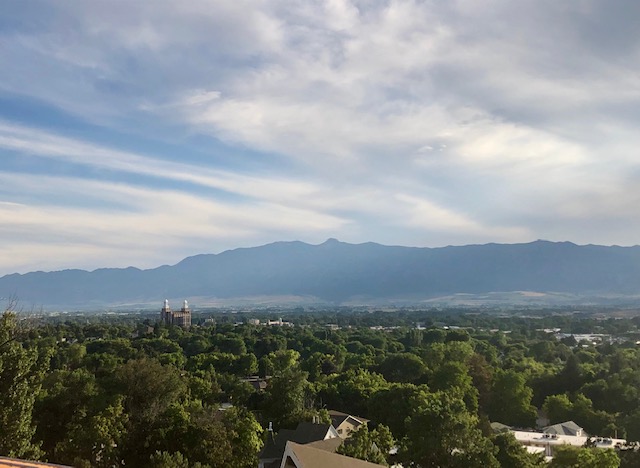
    I recently moved from Logan, Utah to Milwaukee for a faculty position at the University of Wisconsin (wait for it) Milwaukee. The nature of academia means you move where the job takes you. I’m pleased that it took me to a new part of the country and a new work environment with supportive and welcoming faculty and staff. The goal for many leaving a doctoral program or post doc (as I did) is a tenured track faculty position. A challenge to achieve that (honestly) I try to share with doc students or those considering entering a doctoral program. During your last year of a doc program or post doc, you apply, apply, apply, interview, interview, wait (for what seems like an excruciating amount of time), and maybe have an on-campus interview and (possibly) get something. There’s so many of us searching for these idealized tenure track positions while there are so few of actual positions to go around. I am where I am now for a number of reasons (hard work, mentorship, networking, a great post doc). Some that I may not even know about. I am happy where I am. But the transitional period from post doc to faculty and from Utah to Wisconsin has been much harder that I expected.

    (more…)